

Democrats took both the House and the Senate on Tuesday, and bond buyers showed up Wednesday morning. The 10-year Treasury yield slipped 3.5 basis points to 4.914%. The 2-year touched a two-month low of 4.546% before settling near 4.603% (WSJ).
A basis point is one hundredth of a percentage point. The 30-year bond eased 4 basis points to 5.289% (CNBC). The dollar index fell 0.5% to 101.31, and gold futures jumped 2.8% to $4,052.50 an ounce, back above $4,000 (WSJ).
This election was about prices. In AP polling cited by the WSJ, roughly 39% of voters named the economy as the top issue, and nearly 90% said the cost of living drove their vote. Inflation ran at 3.7% in September, and real wages have fallen for six months (WSJ). Investors now face one question: is this rally the start of a trend, or a one-day sigh of relief?
Why the Market Exhaled
Three things lined up at once:
Spending restraint. With a hostile Congress, analysts see less chance of bills that widen the deficit (WSJ). JPMorgan traders said Wall Street is focused on "reduced deficit spending," which Congress could force through budget fights or even a shutdown (CNBC).
Cheaper oil. Brent fell 1.3% to $102.30 a barrel and WTI slipped 0.7% to $95.33. Deutsche Bank says prices keep falling if the Middle East stays quiet, and notes that Trump has admitted the Iran war helped Democrats win (WSJ). That follows a nearly 8% drop in Brent on Monday, driven by reports of diplomatic progress between Washington and Tehran (FT).
Slower growth, cooler prices. Brokerage XM argues that tax cuts, new stimulus and deregulation are now less likely. That could slow the economy but also ease fears of runaway inflation and more Fed hikes (WSJ).
Mortgage Rates Are Easing, From a High Perch
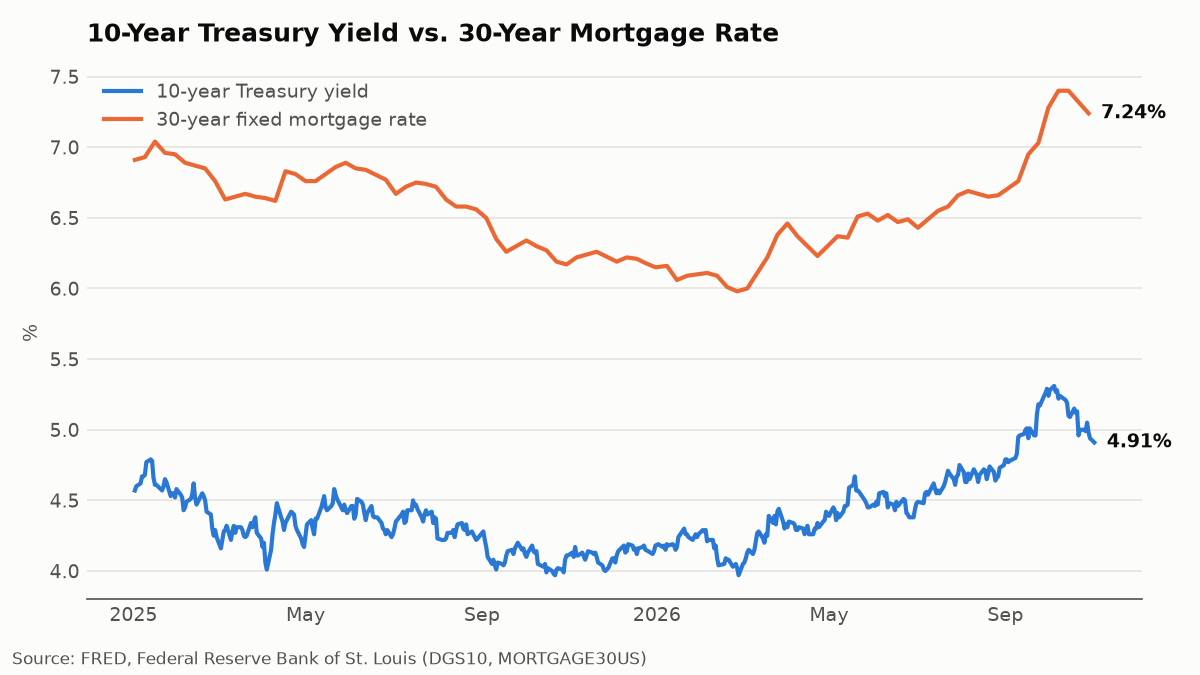
The 10-year yield slid from 5.15% on Oct. 19 to 4.91% on Nov. 2. The weekly 30-year fixed mortgage rate eased from 7.4% in mid-October to 7.24% on Oct. 29, still well above the 6.65% it posted on Aug. 20.
The Mortgage Bankers Association's numbers tell a similar story. Its average 30-year contract rate dipped to 7.3% from 7.37%, the third weekly decline in a row (CNBC). So how can rates fall for three straight weeks while buyers keep walking away? Because the drop is small next to the September spike that froze housing.
Purchase applications fell 2% on the week and sit 19% below a year ago.
Refinance demand is 60% lower than the same week last year, since rates remain about a full point above where they were then.
More borrowers are choosing adjustable-rate loans to shrink their starting payment.
The relief may already be fading. Mortgage News Daily says rates crept higher early this week after a hotter-than-expected job openings report (CNBC).
Gridlock Doesn't Shrink the Debt
The mainstream read says divided government means less borrowing, which means lower yields. Vontobel's Andrew Jackson pokes a hole in that: "Blocking new spending is not the same as reducing the existing deficit" (WSJ). Jackson warns that ongoing deficits and heavy Treasury issuance could put a floor under long-term yields, and that inflation and the Fed will matter more to bonds than the vote.
Some analysts expect more spending, not less. SEB thinks the power shift will lead to a slightly more expansionary fiscal policy (WSJ). On Wealthion, Chris Casey of Windrock Wealth Management argues that when power is split, the only way to pass anything is to hand something to every side. In his view, spending and deficits will hold steady or grow (Wealthion).
The Fed also hasn't changed course. Traders still price a nearly 83% chance of a December rate hike, according to CME's FedWatch tool (WSJ).
Opposing Views
The Bull Case
A Congress that can block Trump's fiscal agenda limits new borrowing, and Jackson agrees this can support Treasurys (WSJ). Saxo Bank's Ole Hansen ties gold's rally to the same hope: a check on unaffordable fiscal expansion (WSJ). Edmond de Rothschild's Nabil Milali adds that the presidential veto should stop any large new Democratic programs. If Deutsche Bank is right that oil falls without fresh escalation, lower energy prices could cool inflation and pull yields down further (WSJ).
The Bear Case
Capital Economics' Neil Shearing argues that a president boxed in at home may turn to foreign policy, where he has more freedom. Renewed strikes on Iran could send Brent above $120 (WSJ).
Peter Schiff says interest on the national debt will top Social Security spending next year even if rates stay put. Schiff believes the Fed is trapped, unable to fight inflation without triggering a crisis (Peter Schiff). The Wealthion episode goes further, raising the possibility of a 7% 10-year yield heading into the 2028 election (Wealthion). Inflation pressure isn't only a U.S. story, either: eurozone inflation hit 4.0% in October, above forecasts (WSJ).
Conclusion
The election changed who controls Congress, not the size of the debt or the pace of inflation. Wednesday's bond rally looks more like relief than a turning point.
Treat the drop in yields as a reaction to one event, not proof that rates have peaked.
Watch oil and Iran headlines. Calm pushes yields down, while escalation could push Brent above $120.
Keep an eye on the December Fed meeting. Markets still expect a hike.
Homebuyers waiting for cheap mortgages may wait a long time. Rates are only edging down from a September spike.
Gold's bounce reflects deficit worries that gridlock won't solve.
Sources
Treasury Yields Decline After Democrat Triumph; Eurozone Bond Yields Trade Mixed - WSJ, 2026-11-04
Treasury yields fall after Democrats win House and Senate majorities - CNBC, 2026-11-04
Gold Climbs on Softer Dollar, Falling Treasury Yields After U.S. Midterms - WSJ, 2026-11-04
‘We’re Just Fed Up’: How Economic Fury Delivered Democratic Sweep - WSJ, 2026-11-04
Oil Prices to Come Under Pressure if Midterms Outcome Halts Iran Escalation - WSJ, 2026-11-04
Oil price extends decline to $103 - FT, 2026-11-03
Mortgage rates drop for the third straight week, but homebuyers are still leaving the market - CNBC, 2026-11-04
7% Treasury Yields by 2028? The Midterm Warning - Wealthion (YouTube), 2026-11-02
Debt Interest Is About to Pass Social Security... Here's What Breaks - Peter Schiff (YouTube), 2026-11-03
10-Year Treasury Yield vs. 30-Year Mortgage Rate - Source: FRED, Federal Reserve Bank of St. Louis (DGS10, MORTGAGE30US)
10-Year Treasury Yield vs. 30-Year Mortgage Rate - Source: FRED, Federal Reserve Bank of St. Louis (DGS10, MORTGAGE30US)
Thanks For Reading!
If you have any source you wish to see in our lineup, please reach out and let us know.
It's been a while since our last issue. If these emails aren't for you anymore, you can unsubscribe here, no hard feelings.