

Treasuries are heading for their worst week since the April 2025 liberation day tariff shock. The 10-year yield reached 5.16% on Friday, up 0.3 percentage points from the end of last week (FT). The two-year moved even faster, rising 0.36 points this week to 4.88%, its biggest jump since late 2024.
The dollar index hit 103.277, its highest since April 2025 (WSJ). Sales of existing homes dropped to their lowest level since 2010 (WSJ).
The trigger was October's consumer price index. It rose 0.4%, beating forecasts for the third month in a row (CNBC). Chicago Fed president Austan Goolsbee called the report "borderline disturbing" (CNBC).
For a regular investor, the question is no longer when the Fed cuts. It is how many more times the Fed hikes.
The Market Now Expects Hikes, Not Cuts
The Fed lifted its target range to 3.75%-4% in September and held in October (CNBC). Futures now fully price a quarter-point increase in December (FT). CNBC puts the odds of a half-point move at 15%, an idea Governor Christopher Waller raised this week.
A January hike, given 10% odds a week ago, is now largely priced in. A third by June is fully priced (FT).
New York Fed president John Williams, usually a centrist voice, sounded firm. Williams called the economy strong and said the labor market keeps strengthening. Williams also described inflation as persistent (WSJ).
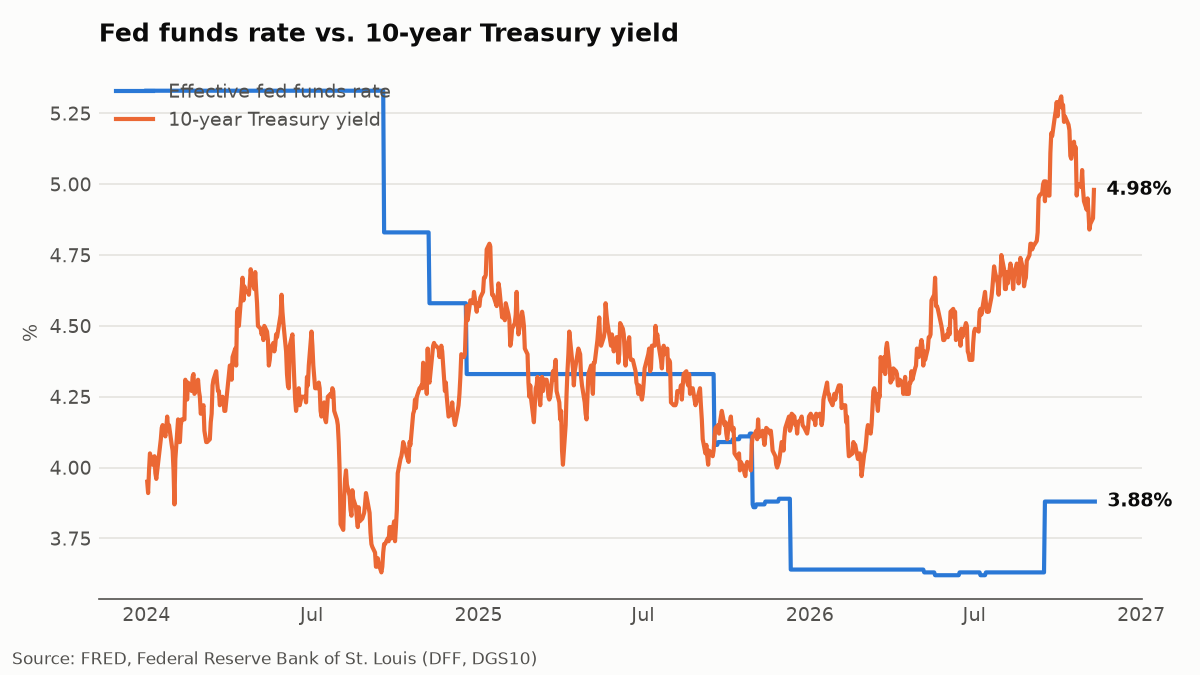
The effective fed funds rate held flat at 3.88% from Oct. 31 through Nov. 11. Over a similar stretch the 10-year yield swung from 5.05% on Oct. 28 down to 4.84% on Nov. 5 and back up to 4.98% on Nov. 10.
How Can Gas Prices Fall and Inflation Still Get Worse?
Cheaper gasoline makes this look like a contradiction. It isn't, because price pressure has spread well beyond energy.
Core CPI, which strips out food and energy, rose 0.3% for the third straight month (WSJ).
Two Cleveland Fed gauges that drop outliers both point higher. The median CPI ran at a 3.7% annual rate and the trimmed-mean CPI at 4.5% (same source).
The Atlanta Fed's sticky-price index, which tracks prices that change slowly, sped up to a 4.7% annualized pace, the fastest since February 2025 (Axios).
Food prices rose 0.5% in October as higher freight costs fed through. Medical services and auto insurance also accelerated, as did hotels (Barron's).
WSJ's Greg Ip explains the stakes. If inflation is stuck near 3% rather than drifting down on its own, a light touch on the brakes won't be enough. The Fed would have to deliberately cool the economy, which means slower growth and more unemployment (WSJ).
Housing and Stocks Take the First Hit
Housing is where higher rates show up first (FT):
Existing-home sales fell 5.5% in October to a 3.75mn annual pace. That is the slowest since August 2010 and below the 3.85mn forecast.
Inventory rose to 1.59mn homes, or 5.1 months of supply.
Mortgage rates reached as high as 7.5% in early October.
Jefferies expects October's rate jump to drag on sales in November and December.
Stocks look less stretched than the selloff might suggest. Barron's notes the S&P 500 trades at about 18 times expected earnings, close to its 10-year average. The problem is momentum.
Since Kevin Warsh's Senate confirmation as Fed chair, the 10-year yield has climbed nearly a full point (Barron's). Over that span the S&P 500 has gained less than 1% despite strong earnings (Barron's). Rising yields are eating all of that profit growth.
Opposing Views
The Bull Case
Mary Ellen Stanek of Baird Advisors, who has 47 years in fixed income, argues investors shouldn't flee bonds at these yields (Barron's). Her points:
The Bloomberg U.S. Aggregate index paid a 3.2% yield after inflation in the third quarter.
At the end of the third quarter, the 10-year Treasury yielded 5.29%, compared with an S&P 500 earnings yield of 3.81%. Treasury yields were last that high in 2002.
Baird's municipal bond fund yields 4.86%, which works out to 8.21% for someone in the top 40.8% tax bracket.
Stanek expects just one more quarter-point hike. She favors intermediate bonds in the five-to-six-year duration range, a measure of how much a bond's price moves when rates change.
Governor Michelle Bowman supports a gentler path. Bowman notes that falling stocks, higher borrowing costs and a stronger dollar are already tightening conditions for the Fed (Axios).
The Bear Case
Economist Steve Hanke warns of a meaningful risk of a financial crisis, pointing to heavy investment and rising credit exposure on top of stretched valuations. In that scenario, Hanke says, the broad stock market could fall 40% (Wealthion).
Hanke expects the bond bear market to continue, with the 10-year yield possibly staying above 5%. Hanke would put new money in money market funds rather than stocks (Wealthion). Carson Group's Sonu Varghese argues that the longer the Fed waits, the more economic and market pain it is likely to cause in the end (Barron's).
The signal to watch is the yield curve. The WSJ's Economics newsletter puts the two-year yield 0.25 percentage point below the 10-year (WSJ). The newsletter treats a move above it as the point to start weighing a recession (WSJ).
Conclusion
The Fed's next move looks like a hike, and inflation is now broad enough that lower gas prices won't stop it. That is a gut punch for homebuyers and for stocks that need falling rates. It is good news for anyone who wants to lock in income.
Plan for higher-for-longer rates. Futures price hikes into 2027, not cuts.
Watch core and trimmed-mean CPI, not gas prices, to read the Fed.
Treat a two-year yield above the 10-year as a recession warning.
Intermediate bonds and munis offer income not seen in decades, but expect price swings if Hanke is right.
Hold cash in money market funds while the Fed decides how hard to push.
Sources
US Treasuries set for worst week since Trump’s ‘liberation day’ - FT, 2026-11-13
Fed faces tougher inflation fight as pressure builds for more rate hikes - Axios, 2026-11-12
Fed's Goolsbee calls inflation report 'borderline disturbing' as central bank weighs more hikes - CNBC, 2026-11-11
Fed’s Williams Says Still Work to Do to Get Monetary Policy to Right Place - WSJ, 2026-11-13
The Inflation Fight May Be About to Turn Painful - WSJ, 2026-11-12
Dollar Extends Gains as Rate-Hike Bets Firm - WSJ, 2026-11-13
US home sales fall to lowest level since 2010 as mortgage rates soar - FT, 2026-11-12
Why Falling Gas Prices Won’t Solve the Inflation Problem - Barron's, 2026-11-11
Rising Yields Don’t Scare This Veteran Bond Investor. What She’s Buying Now - Barron's, 2026-11-12
Stocks Get a Much-Needed AI Boost—But the Fed Could Spoil the Party - Barron's, 2026-11-11
Steve Hanke Warns: A Financial Crisis Could Send Stocks Down 40% - Wealthion (YouTube), 2026-11-11
Fed funds rate vs. 10-year Treasury yield - Source: FRED, Federal Reserve Bank of St. Louis (DFF, DGS10)
Fed funds rate vs. 10-year Treasury yield - Source: FRED, Federal Reserve Bank of St. Louis (DFF, DGS10)
Thanks For Reading!
If you have any source you wish to see in our lineup, please reach out and let us know.
It's been a while since our last issue. If these emails aren't for you anymore, you can unsubscribe here, no hard feelings.
Median CPI at 3.7% and trimmed mean at 4.5% is what undercuts the cheap gasoline story. If the Fed really has to cool things on purpose, which cracks first, housing or jobs?