

The U.S. economy added 165,000 jobs in October, far above the 59,000 economists polled by the WSJ had penciled in, and the unemployment rate slipped to 4.1% from 4.2% (WSJ). August and September were revised up by a combined 84,000, lifting the three-month average to 137,000 jobs a month (FT).
For investors, the timing is awkward. The report landed a day after the Nasdaq Composite fell 5.5% in an AI-led selloff (WSJ), and it gives the Fed another reason to raise rates in December.
Traders pushed the odds of a quarter-point hike at the Dec. 8-9 meeting to 76.8%, according to CME's FedWatch, and Treasury yields rose across the curve (CNBC). Good news for workers is bad news for anyone praying for a Fed pause.
The Mainstream Narrative: A Labor Market That Can Handle a Hike
The gains were broad, not just healthcare. Per CNBC:
Professional and business services: +70,000
Healthcare: +42,000
Transportation and warehousing: +25,000
Manufacturing: +19,000
That professional services number compares with an average monthly gain of 15,000 over the prior 12 months (WSJ). The labor force also grew by 421,000 and participation edged up to 61.9%. So the unemployment rate fell even as more people looked for work (CNBC).
Wall Street drew the obvious conclusion. "This data, combined with the longer-term trends in inflation, suggest a December hike is almost a lock," said Jefferies chief economist Thomas Simons (FT).
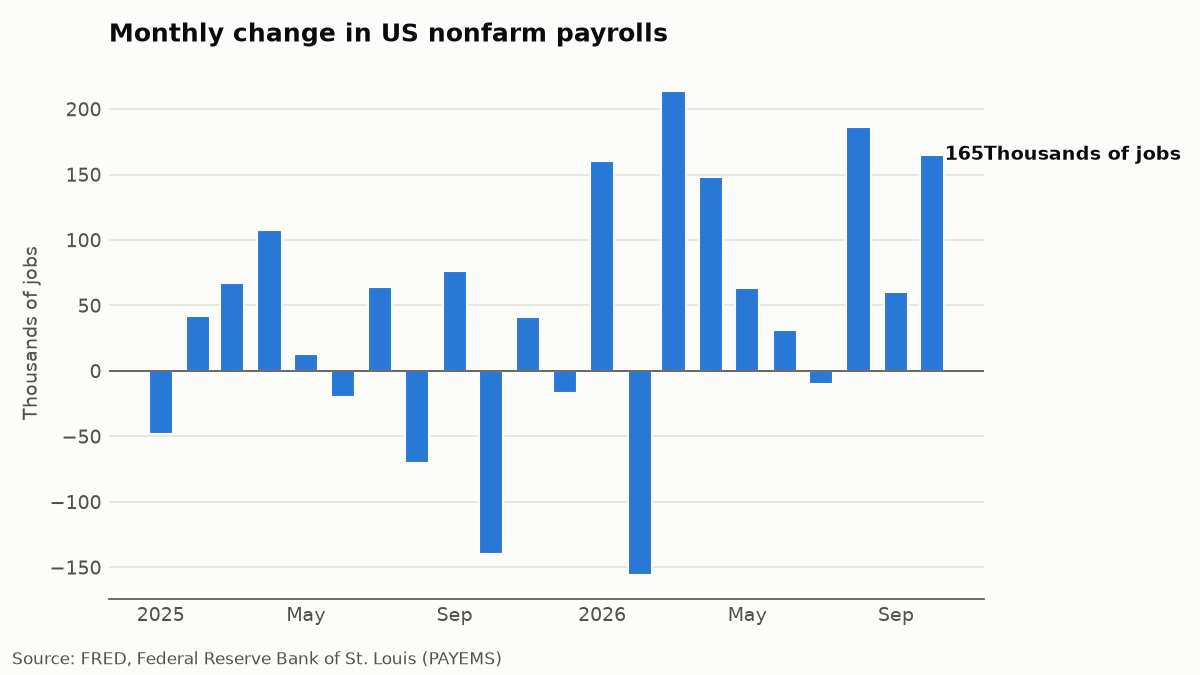
Hiring has swung hard this year: outright declines in February and July, then an upwardly revised +186,000 in August, +60,000 in September and October's +165,000 (CNBC).
That volatility matters. The WSJ notes a Labor Department methodology change this year may have amplified monthly swings (WSJ). With fewer workers entering the market, Yale's Budget Lab puts the break-even pace of hiring at just over 5,000 a month (AP). A single big payroll number says less than it used to.
Underneath the Headline: Longer Searches, Shrinking Paychecks
How can the job market be booming if the people inside it are falling behind? Look past the topline:
The broad U-6 underemployment rate rose 0.3 percentage point to 7.9% (CNBC).
The average spell of unemployment hit 27.1 weeks, the longest since September 2021 (CNBC).
1.96 million people have been jobless for more than 27 weeks (CNBC). That group made up 27.6% of the unemployed, the highest share since late 2021 (CNBC).
Average hourly earnings rose 3.1% from a year ago, against September CPI inflation of 3.7% (CNBC).
The WSJ says that is likely the seventh straight month pay trailed prices. The WSJ also reports labor's share of business output fell to 53% in the third quarter, the lowest in 80 years of records (WSJ).
Even a Fed hawk sees it. San Francisco Fed President Mary Daly said households are "not out of the game, but they are on a treadmill of high inflation" (CNBC).
This cuts against the wage-price spiral story. Unit labor costs fell at a 0.7% annualized rate in the third quarter thanks to strong productivity, while hourly compensation grew at a 2.9% rate (FT). Don't blame workers for higher prices.
Why the Hawkish Move May Be Peaking
The bond market's reaction was smaller than the headline. The two-year yield closed at 4.520% and the 10-year at 4.858%, yet the two-year has now fallen six weeks in a row and the 30-year five weeks in a row (WSJ).
The FT reports the initial jump in yields and the dollar quickly faded. Bespoke's George Pearkes told the FT that bond traders care more about inflation right now (FT).
FedWatch prices just one more hike after December. Odds for 2027 increases have slipped since the midterms and the tech selloff (CNBC).
The tiebreaker comes Tuesday. October CPI is the last inflation report officials see before the December meeting, the WSJ's Nick Timiraos writes. Timiraos adds that Chair Kevin Warsh has been openly skeptical of leaning on backward-looking monthly data (WSJ).
Opposing Views
The Bull Case
The WSJ's Telis Demos argues Treasuries remain a strong hedge against an AI unwind. Yields are still near generational highs, Demos notes, and the 10-year sat below 4% fewer than nine months ago. Over the past month, Demos adds, the S&P 500 is down around 5% while a Treasury index is up close to 3% (WSJ).
Pence Wealth Management's Dryden Pence is also hopeful on prices. "The long-term trajectory for inflation we believe is lower" (WSJ).
The Bear Case
An FT analysis expects a December hike plus a third increase early next year as the Fed reverses its three late-2025 insurance cuts. In the FT's view, only an equity rout is likely to force a pause (FT).
Wolf Richter points to a tightening market: three-month annualized wage growth jumped to 3.9%, the highest in 11 months (Wolf Street). Employ America says wage growth may be turning up (Employ America). Demos also warns new Democratic spending could add bond supply and push yields up (WSJ).
Conclusion
October's jobs report all but locks in a December hike. Yet falling real pay and longer job searches, plus a fading bond-market reaction, suggest the Fed's hawkish run is closer to its end than its start.
Treat a December hike as the base case; FedWatch odds sit at 76.8%.
Watch Tuesday's October CPI: a soft print strengthens the case that December is the last move for a while.
Don't read too much into one payroll number; the unemployment rate and long-term joblessness tell you more.
Treasuries still offer diversification if the AI selloff deepens.
Risks to that view: re-accelerating wages, an oil spike, or new deficit spending.
Sources
Robust Hiring Defied Expectations in October, With 165,000 New Jobs - WSJ, 2026-11-06
U.S. economy added 165,000 jobs in October, way more than expected; unemployment rate slips to 4.1% - CNBC, 2026-11-06
US economy outstrips forecasts to add 165,000 jobs in October - FT, 2026-11-06
Blowout October payrolls data sets up Federal Reserve December rate rise - FT, 2026-11-06
Solid Jobs Report Leaves Inflation, Markets to Settle Fed’s December Call - WSJ, 2026-11-06
Americans are on a 'treadmill of high inflation' and more rate hikes are likely, Fed's Daly says - CNBC, 2026-11-06
Treasury Yields Rise on Strong Jobs Data - WSJ, 2026-11-06
Signs Pile up of a Solid and Tightening Labor Market - Wolf Street (RSS), 2026-11-06
October 2026 Labor Market Recap - Employ America (RSS), 2026-11-06
A disturbing employment trend is hiding beneath the latest strong job numbers - CNBC, 2026-11-06
US continues to generate jobs, yet inflation is eroding the spending power of millions of Americans - AP, 2026-11-06
The Argument for Buying Treasury Bonds Is Still Strong - WSJ, 2026-11-06
U.S. Stocks Mixed After Jobs Data, Muted AI Rebound - WSJ, 2026-11-06
Monthly change in US nonfarm payrolls - Source: FRED, Federal Reserve Bank of St. Louis (PAYEMS)
Thanks For Reading!
If you have any source you wish to see in our lineup, please reach out and let us know.
It's been a while since our last issue. If these emails aren't for you anymore, you can unsubscribe here, no hard feelings.