

The U.S. economy grew at a 3.4% annual rate in the third quarter, the Commerce Department said Thursday. Economists surveyed by the Wall Street Journal had expected 3.1%. Growth also sped up from 2.2% in the second quarter, the fastest pace in a year (WSJ). Consumer spending rose at a 3.8% clip, and business investment excluding housing jumped 12.7% on the AI build-out (AP).
The same morning, the Fed's preferred inflation gauge, the PCE price index, climbed to 3.6% over 12 months, up from 3.4% a month earlier (WSJ). A day before that, the Fed held its benchmark rate in a range between 3.75% and 4% on a 10-2 vote. Governor Lisa Cook and Cleveland Fed President Beth Hammack dissented, favoring a quarter-point increase (WSJ).
The Mainstream Narrative: The Economy Is Firing
The details mostly back up the headline:
Final sales to private domestic purchasers rose at a 4.9% rate, up from 4.6%. That gauge of underlying demand, which leaves out government, inventories and trade, grew at its fastest since the second quarter of 2021 (WSJ).
Initial jobless claims fell to 194,000, near levels last seen in the late 1960s (CNBC).
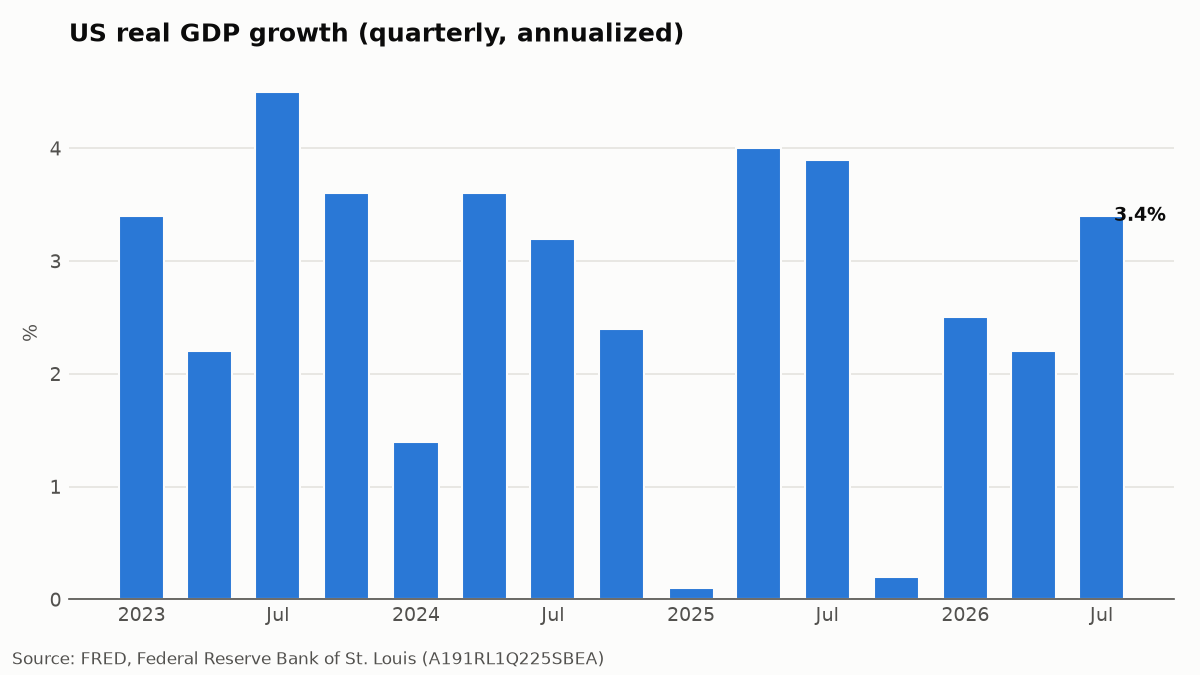
FRED data show growth whipsawing from 0.1% in early 2025 and 0.2% in late 2025 to 3.4% in the third quarter of 2026, up from 2.2% in the second quarter.
How Can Spending Be This Strong If Households Are Squeezed?
Consumers are spending, but the money is increasingly coming out of savings, not paychecks. AP reports that wealthier Americans, flush with record stock market gains, are leading the spending (AP).
Inflation-adjusted consumer spending was flat in September after rising 0.5% in August (WSJ).
Real after-tax income dipped in September and sat only 1% above its level a year ago, while inflation-adjusted spending grew 2.5% (AP).
The personal savings rate drifted down to 3.8%, the lowest since late 2022 (FT).
The rate-sensitive corners of the economy are already bleeding. Housing investment dropped 3.3% and has fallen six of the last seven quarters (AP). Net exports also subtracted 3.32 percentage points from growth as imports of chips, turbines and copper poured in, though the WSJ editorial board calls that an accounting quirk (WSJ Opinion).
The Real Risk Is Rates, Not Recession
Inflation is not just energy anymore. The monthly PCE gain of 0.5% was the largest since March (CNBC). Core PCE, which strips out food and energy, accelerated to 3.1% from 3% (WSJ).
Gasoline and other energy goods rose 9.2% in the month, but transportation services prices also rose 2.1%, the fastest since 2022 (CNBC, FT). TD's Ksenia Bushmeneva sees price pressures starting to build (AP).
The market already expects the Fed to respond. Futures price in a hike in December (WSJ), and the FT's analysis sees a December move followed by another in next year's first quarter (FT). Fed Chair Kevin Warsh also pushed back on the idea that the AI boom is immune to higher rates: “Interest rates get in the cracks” (WSJ).
Why this matters for stocks: the bond market. The 10-year Treasury yield fell 0.056 percentage point to 4.988% on Thursday (WSJ). Earlier this month, though, long-term yields hit their highest in more than two decades. Some lower-rated borrowers riding the AI spending wave now pay more for credit (WSJ).
On the day, the S&P 500 closed 0.3% lower and the Nasdaq 100 dropped 1.4% (FT). When a growth beat sends tech lower, the market is telling you exactly what scares it.
Opposing Views
The Bull Case
Warsh's argument is productivity: a more efficient economy can run faster before prices take off. “Is the economy running too hot? That isn't the judgment of most of my colleagues,” he said (WSJ).
The WSJ editorial board puts productivity growth at an average 2.25% a year since January 2025, against 1.3% over 2010-2019 (WSJ Opinion). On a quarterly basis, PCE prices rose 2.1% headline and 2.5% core, down from 5% and 3.3% in the second quarter (CNBC).
In a Wealthion interview, a market strategist argues the rally rests on broad, sturdy earnings for this year and next, not just AI. The strategist reads the flush-out of leveraged chip bets as healthy, and is bullish on balance (Wealthion).
The Bear Case
Bianco Research's Jim Bianco found the inflation number more telling than GDP and asked: “why didn't the Fed hike rates again?” (FT). Former Fed economist Riccardo Trezzi went further, putting core prices likely at a 4% annualized pace. To Trezzi, skipping an October hike made no sense on risk-management grounds and simply looked too dovish (WSJ).
RSM's Joe Brusuelas made the case for action from strong spending, rock-bottom jobless claims, soaring business investment and hot inflation (AP). TD's Bushmeneva expects consumer demand to suffer over the next few quarters as real income shrinks and the savings cushion thins, with pricier credit adding to the drag (AP).
Conclusion
This GDP beat makes a near-term recession look unlikely, but it also strengthens the case for higher rates. The threat to the rally has shifted from weak growth to the cost of money.
Watch the December 9 Fed meeting: futures already price a hike, so the surprise would be a hold.
Watch core PCE and services inflation, not just gasoline; the broadening is what keeps the Fed hawkish.
Watch long-term Treasury yields, with the 10-year at 4.988% Thursday; mortgage rates track longer-term yields.
Rate-sensitive sectors like housing and appliances are already hurting while high-end consumers keep spending.
A falling savings rate means consumer strength is running on fumes for many households.
Sources
U.S. Economy Picked Up Speed, With GDP at 3.4% Rate in Third Quarter - WSJ, 2026-10-29
US economy beats forecasts to grow at 3.4% rate in third quarter - FT, 2026-10-29
US economy grows at brisk 3.4% pace in third quarter on strong consumer spending and AI investment - AP, 2026-10-29
Third-quarter U.S. GDP increases a better-than-expected 3.4% as September inflation accelerates - CNBC, 2026-10-29
PCE Inflation Accelerated Last Month - WSJ, 2026-10-29
Fed Holds Rates Steady but Two Officials Sought Another Increase - WSJ, 2026-10-28
Strong US inflation and growth will keep Fed on a tightening path - FT, 2026-10-29
The U.S. Investment Boom Arrives - WSJ, 2026-10-29
Strong growth and inflation paints mixed picture of economy days before midterm elections - AP, 2026-10-29
Treasury Yields Fall Following Major Central Banks’ Hold - WSJ, 2026-10-29
Everyone's Too Bearish: Why the U.S. Economy Keeps Defying Expectations - Wealthion (YouTube)
US real GDP growth (quarterly, annualized) - Source: FRED, Federal Reserve Bank of St. Louis (A191RL1Q225SBEA)
Thanks For Reading!
If you have any source you wish to see in our lineup, please reach out and let us know.
It's been a while since our last issue. If these emails aren't for you anymore, you can unsubscribe here, no hard feelings.