

The S&P 500 slid into correction territory on Nov. 20 for the first time since April 2025. It fell 3.7% that day to close at 6,910.39, its seventh straight loss, leaving the index 11.6% below its Oct. 6 record close of 7,818.93 (CNBC).
The Nasdaq briefly crossed into a bear market, down 20% from the same October peak (Barron's). A rally this week narrowed the damage, but the S&P 500 is still more than 6% off its high (WSJ).
The bond market gave stocks no holiday break after Thanksgiving. On Friday the 10-year Treasury yield rose 7.4 basis points to 4.921% and the two-year climbed 6 basis points to 4.693% (WSJ). Traders fully expect a quarter-point hike at the Fed's Dec. 8-9 meeting.
Most investors are asking whether stocks bounce on AI. The better question: does a Fed tightening into a sell-off turn an ordinary pullback into a real slowdown?
Why the Warsh Fed Won't Blink
On inflation, the Fed has little cover to pause. The PCE price index, its preferred gauge, rose to 3.8% in October, and core PCE (excluding food and energy) sped up from 3.1% to 3.3%. The Fed has missed its 2% target for almost six years.
Third-quarter growth ran at a 4.3% annualized pace, up from 2.2% in the second quarter (FT). That figure was revised up from 3.4% (Axios).
Officials also see inflation spreading beyond chips. Chicago Fed president Austan Goolsbee says construction and electrical components tied to data centers are getting sharply more expensive. New York Fed president John Williams blames tariffs, supply problems and AI-driven demand (FT). Governor Christopher Waller wants a half-point move (FT).
New Century Advisors' Claudia Sahm doubts the Fed will budge from its inflation focus unless the sell-off gets considerably deeper (FT). Zurich's Guy Miller adds that the old "Fed put" (the idea that the central bank rescues falling stocks with cheaper money) is weaker under Warsh.
The Tightening Is Already Happening Without the Fed
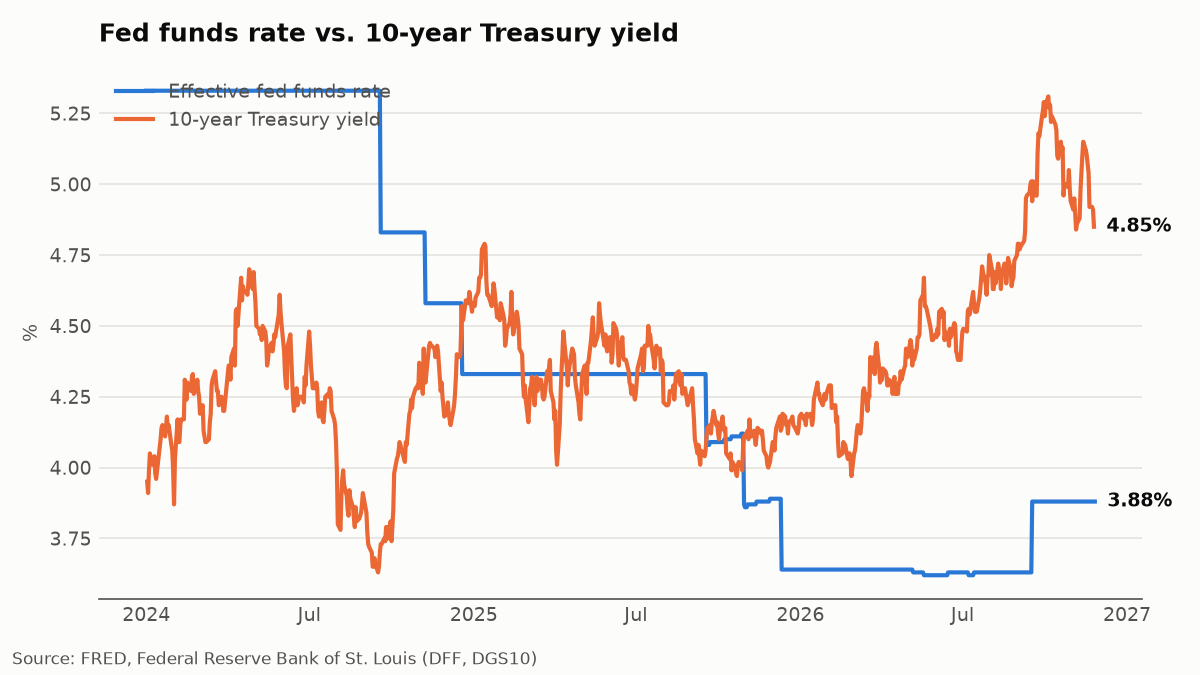
The effective fed funds rate sat at 3.88% through Nov. 26, while the 10-year yield peaked at 5.15% on Nov. 13 and eased to 4.85% by Nov. 25.
That gap is the tell. Barron's reports the 10-year yield fell 17 basis points over the past month to 4.83% on Wednesday, while the three-month T-bill yield rose 13 basis points to 4.25%. Capital Economics' Jonas Goltermann reads short rates rising against long ones as a market bet that tight policy will hurt growth and profits (Barron's).
The stock drop is doing tightening work on its own:
Stocks make up over 70% of households' liquid assets, per BlackRock's Rick Rieder.
Goldman Sachs' David Mericle estimated tighter financial conditions, if they last, would cut 0.5% from growth between the fourth quarter of 2025 and the fourth quarter of 2026 (Barron's).
University of Hawaii economist Byron Gangnes found the AI buildout's direct boost to growth has been small, with the larger lift coming through the stock market's wealth effect on spending (RIA).
Fed staff flagged in the October minutes that off-balance-sheet leases and circular financing among AI firms could magnify losses if AI returns disappoint (RIA).
The wealth effect may be what's carrying spending. If so, a Fed that hikes into falling stocks is pressing on the economy's main support.
History's Comfort Comes With Fine Print
The reassuring stat: of 13 S&P 500 bear markets, eight overlapped with recessions and five did not, including 1987 and 2022 (CNBC). A 10% correction is a far smaller event.
But look at the conditions. Deutsche Bank's Henry Allen finds every bear market since 1962 came with a recession, deteriorating data, or a Fed hiking cycle. Allen argues none apply yet, and that rate pricing has actually turned slightly more dovish since the Oct. 6 peak.
So how can a hiking cycle be absent when the Fed hiked in September and is about to go again? Allen is measuring the shift in expectations, not the hikes themselves. Markets still price 71 basis points of increases by mid-2027 (WSJ). One of his three warning signs is arguably already flashing; it just hasn't gotten worse.
Opposing Views
The Bull Case
UBS strategist Gerry Fowler sees signs the selling is exhausted, with risk-control funds poised to buy as volatility eases (WSJ). RIA notes the equal-weight S&P 500 sits only about 3% below its Nov. 4 record, meaning the average stock is healing (RIA).
The November flash composite PMI of 54.6 shows business activity still expanding (CNBC). Jefferies' Mohit Kumar expects December to mark peak Fed hawkishness (Barron's). Barron's also points to falling commodities and a firmer dollar as easing inflation pressure (Barron's).
The Bear Case
Hedge fund manager Bill Ackman warns continued hikes risk a U.S. and global recession (FT). Treasury Secretary Scott Bessent says many fear the Fed is over-tightening (FT). XTB's Kathleen Brooks says questions about AI profitability and financing costs remain unresolved (WSJ). TS Lombard's Steven Blitz argues the equity market, not loan supply, is now the real policy lever, making stock damage more costly for the economy (Barron's).
Conclusion
Corrections usually stay corrections, but the usual cases didn't have a Fed raising rates while stocks fell and the economy leaned on stock wealth. That combination is what turns a routine pullback into a growth risk.
Expect a quarter-point hike on Dec. 9; watch whether the Fed signals more for 2027.
Track the gap between short and long Treasury yields; further flattening points to growth fears.
Watch breadth: an improving equal-weight index is healthier than a mega-cap bounce.
Watch consumer spending data, since the wealth effect is the channel most exposed.
Don't count on a Fed put; Sahm and Miller both suggest the bar for a rescue is high.
Sources
Hawkish Fed poised to raise rates despite stock market turmoil - FT, 2026-11-26
Warsh’s ‘good family fight’ could turn ugly - FT, 2026-11-27
Stocks’ Swoon and Higher Interest Rates Are a Bad Combo for the Economy - Barron's, 2026-11-26
U.S. Treasury Yields Rise in Shortened Post-Thanksgiving Trade - WSJ, 2026-11-27
The S&P 500 is in a correction. Bear markets and recessions don't always follow - CNBC, 2026-11-27
Stocks Poised to End Week Strong as Investors Take Break From AI Jitters - WSJ, 2026-11-27
AI Off-Balance Sheet Financing Worries The Fed - Real Investment Advice Ria Bull Bear Report (RSS), 2026-11-27
Jobless Growth: What A Shrinking Workforce Means For Investors - Real Investment Advice Ria Bull Bear Report (RSS), 2026-11-27
Trump demands investigation into GDP data revisions - Axios, 2026-11-26
Fed funds rate vs. 10-year Treasury yield - Source: FRED, Federal Reserve Bank of St. Louis (DFF, DGS10)
Fed funds rate vs. 10-year Treasury yield - Source: FRED, Federal Reserve Bank of St. Louis (DFF, DGS10)
Thanks For Reading!
If you have any source you wish to see in our lineup, please reach out and let us know.
It's been a while since our last issue. If these emails aren't for you anymore, you can unsubscribe here, no hard feelings.
Look, the sneaky bullish line in this whole piece is the equal weight index sitting just 3 percent under its record. The average stock at the bar is doing fine, it is the big names at the top shelf doing the bleeding. But come on, the Fed is about to hike on Dec 9 right into a correction, PCE is running 3.8, and there is no rescue coming if this slips. I am not arguing with that tape. My weekly read on $SPY is 41 Weak FADE, closed Friday at 728.32, and it stays a fade until a daily close takes back 734.18. Breadth can heal all it wants. Until that line breaks, every rally is a chance to sell, not a reason to chase.
#TheWeekendCard