

Consumer prices rose 0.4% in October, beating the 0.3% economists expected. Core prices, which leave out food and energy, climbed 0.3% against a 0.2% forecast, according to the Bureau of Labor Statistics (CNBC). The BLS skipped an annual rate this time because last year's government shutdown left no October 2025 data to compare against.
Bond traders didn't wait. The 2-year Treasury yield rose 0.18 percentage point to 4.725%, its largest one-day gain since April 9, 2025 (WSJ). The 10-year yield pushed back above 5% (WSJ).
A December hike now looks settled. The open question is how fast the Fed moves after that.
The Headline Cooled. The Problem Didn't.
On the surface, October looks like progress: 0.4% is down from September's 0.6%. Look under the hood and almost all of that relief came from energy. The energy index rose 0.7% in October after jumping 5.2% the month before (FT). Everything else ran hot:
Core rose 0.3% for the third month in a row. WSJ's Economics newsletter points out that any monthly core reading above 0.2% doesn't fit with the Fed's 2% goal (WSJ).
Food rose 0.5% after holding flat in September (Barron's).
Shelter rose 0.3% and made up more than 30% of the headline gain. Electricity rose 0.9% (CNBC).
Smartphone prices jumped 1.4%, the biggest increase on record, and TVs rose 3.3% (AP).
The trend is worse than any single month. Core prices rose at a 3.7% annualized pace over the three months through October, compared with 1.6% for the three months through July (WSJ). The Cleveland Fed's trimmed-mean CPI, which removes the biggest outliers, rose at a 4.5% rate (WSJ).
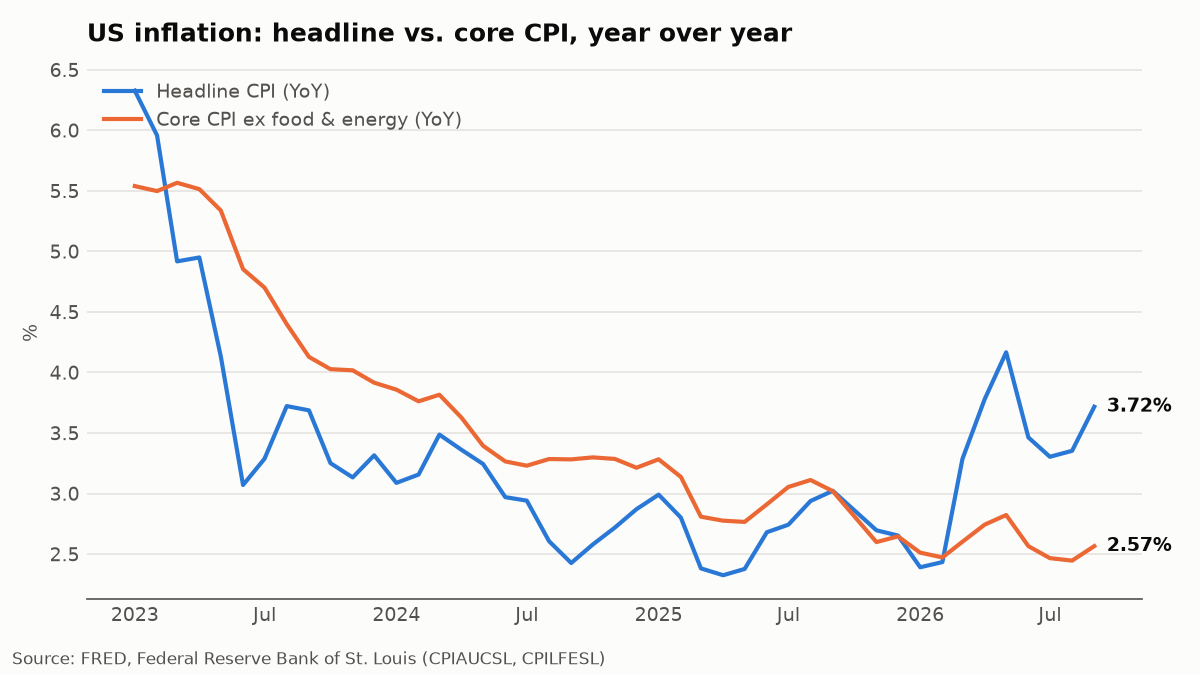
The chart shows headline inflation at 3.72% year over year in September, up from 2.43% in February, while core sat at 2.57%.
How can gas prices be falling while inflation heats up? Because the price increases are spreading. Fed Governor Michelle Bowman said pressures that used to sit in a few categories may now be broadening (AP). Chicago Fed President Austan Goolsbee called the report "borderline disturbing" (CNBC).
Gradual or Faster? The Fed's Real Debate
The Fed lifted its benchmark rate to a 3.75%-4% range in September, then held it there in October. Futures traders now unanimously expect a December hike. They put the odds of a half-point move at 15%, and see a 60% chance that rates reach 4.25%-4.5% by January (CNBC).
The officials who want to move faster:
Christopher Waller said before the release that a core reading near 0.3% should put a half-point hike on the table. He warned that "hiking only 25 basis points would put our credibility at risk" (FT).
Lorie Logan of the Dallas Fed wants at least two more quarter-point increases. She also suggested the Fed could pick up its pace this winter (WSJ).
The officials urging patience:
Anna Paulson of the Philadelphia Fed prefers small steps so households and businesses have time to adjust. She would speed up only if wages, inflation expectations or underlying inflation climbed: "Right now, that's not what I'm seeing" (WSJ).
Bowman warned that financial conditions have already tightened, which reduces the benefit of more hikes (WSJ).
Goolsbee sounds alarmed, especially about inflation expectations becoming entrenched. Still, he declined to commit to a December move, and he doesn't vote until next year (CNBC). Chairman Kevin Warsh has said little either way.
Higher Yields: Pain for AI Stocks, Opportunity for Income
The Nasdaq composite closed down 0.7% Tuesday. Nvidia fell nearly 5% (WSJ). Bowman said investors seem to be rethinking the expected returns on AI spending, which is pushing stock prices down and raising borrowing costs for builders (WSJ).
AI creates a double bind for the Fed: the buildout itself is helping keep inflation high (WSJ). Since mid-May, the 10-year yield has climbed nearly a full percentage point, while the S&P 500 has gained less than 1% (Barron's).
Savers face the opposite picture. Baird's Mary Ellen Stanek notes the 10-year yield stood at 5.29% at the end of the third quarter, while the S&P 500's earnings yield was 3.81%. Treasuries were last that high in 2002 (Barron's).
After inflation, the Bloomberg Aggregate bond index yielded 3.2% in the third quarter. Baird's muni fund yields 4.86%, which works out to 8.21% on a tax-adjusted basis for top earners (Barron's).
Opposing Views
The Bull Case
Barron's Martin Baccardax notes the S&P 500 trades near 18 times forward earnings, among the cheapest levels since 2023. LSEG expects roughly 30% fourth-quarter earnings growth (Barron's). Evercore ISI's Krishna Guha still expects inflation to ease as tariff, energy and AI pressures fade. Pimco's Tiffany Wilding says this is not a repeat of 2022 (WSJ).
The Bear Case
WSJ's Economics newsletter argues that if inflation is stuck near 3%, the Fed will have to slow growth and raise unemployment to bring it down. The 2-year yield is now just 0.25 point below the 10-year, and an inversion would be a recession warning. Goldman Sachs sees leftover price effects lasting through the first half of 2027 (WSJ).
Carson Group's Sonu Varghese says the longer the Fed waits, the more pain it will eventually cause (Barron's). Matt Klein reads the midterm results as voters punishing rising prices above all else, which gives the Fed political cover to hike (The Overshoot).
Conclusion
Falling gas prices flattered the headline number. Underneath, inflation is broadening, and the Fed is now debating speed, not direction.
Watch core CPI, not headline. Three straight 0.3% readings are what changed the Fed's tone.
Treat a December hike as the base case. January is the real swing meeting.
Paulson's tests are the ones to track: wages and inflation expectations would tip the Fed toward faster hikes.
Rate-sensitive AI names stay exposed while the 10-year hovers near 5%.
Income investors can now lock in yields not seen in decades, especially in intermediate bonds and munis.
Sources
Consumer prices rose 0.4% in October, more than expected, complicating Fed's inflation fight - CNBC, 2026-11-10
Monthly US inflation higher than expected in October - FT, 2026-11-10
Hot US inflation seals December rise and brings larger increase into play - FT, 2026-11-10
Yields Jump as Inflation Comes in Hotter Than Expected - WSJ, 2026-11-10
Hot Inflation Revives Wall Street’s Rate Hike Fears - WSJ, 2026-11-10
Fed's Goolsbee calls inflation report 'borderline disturbing' as central bank weighs more hikes - CNBC, 2026-11-11
Fed Forced to Confront Case for Bigger and Faster Rate Rises - WSJ, 2026-11-11
As higher prices seep into broader economy, Fed officials consider faster hikes - AP, 2026-11-11
Fed’s Paulson Urges Gradual Approach to Rate Hikes - WSJ, 2026-11-10
The Inflation Fight May Be About to Turn Painful - WSJ, 2026-11-12
Why Falling Gas Prices Won’t Solve the Inflation Problem - Barron's, 2026-11-11
The Midterms’ Message for the Fed: Hike - The Overshoot Matt Klein (RSS), 2026-11-12
Stocks Get a Much-Needed AI Boost—But the Fed Could Spoil the Party - Barron's, 2026-11-11
Rising Yields Don’t Scare This Veteran Bond Investor. What She’s Buying Now - Barron's, 2026-11-12
US inflation: headline vs. core CPI, year over year - Source: FRED, Federal Reserve Bank of St. Louis (CPIAUCSL, CPILFESL)
US inflation: headline vs. core CPI, year over year - Source: FRED, Federal Reserve Bank of St. Louis (CPIAUCSL, CPILFESL)
Thanks For Reading!
If you have any source you wish to see in our lineup, please reach out and let us know.
It's been a while since our last issue. If these emails aren't for you anymore, you can unsubscribe here, no hard feelings.