

The Fed's preferred inflation gauge just posted its worst annual reading since 2023. The PCE price index rose 3.8% in October, the highest since May 2023 (Wolf Street). Core PCE, which drops food and energy, hit 3.3%, the hottest since November 2023 (Wolf Street). The same morning, the government raised third-quarter GDP growth to a 4.3% annualized pace from its first estimate of 3.4% (FT).
That puts a December rate hike on autopilot, even though the S&P 500 fell into a correction on Nov. 20, closing 11.6% below its Oct. 6 record (CNBC). Traders put the odds of a quarter-point move at 95% on Wednesday (FT). By Friday it was fully priced (WSJ). For investors, the script has flipped: good economic news is now bad market news.
Why the Fed Isn't Riding to the Rescue
Officials are wary of training investors to expect a rescue every time stocks slide, the habit Wall Street calls the Fed put (WSJ). This time, they're watching different numbers:
Inflation is spreading. Core services, more than 60% of consumer spending, rose 3.6% from a year earlier, the worst since February 2025. Airfares jumped 14.4%, and computers and related equipment rose 14.6% on the AI buildout (Wolf Street).
Wages are warming. The November Beige Book upgraded national wage growth from modest to moderate, with acceleration in four of 12 districts. The drivers were living costs and skill shortages, not a broad hiring spree (FT).
Growth isn't a fluke. Real final sales to private domestic purchasers grew at a 5.8% pace. Business investment added 2.2 percentage points to growth, the most since 2011 outside the pandemic rebound (Axios).
Layoffs are rare. Only 189,000 people filed new jobless claims, tying the low for 2026 (Axios).
New York Fed President John Williams says his main worry is how strong AI-related demand has become, and he won't rule out hikes at back-to-back meetings (WSJ). Claudia Sahm of New Century Advisors told the FT that stocks would need to fall further before the Fed blinks (FT).
Former Boston Fed chief Eric Rosengren goes further: falling stocks are one way tighter policy does its job, and cooling the economy means cooling AI spending (WSJ). Zurich strategist Guy Miller summed it up: "There's not the same ‘Fed put’ that might have supported the market in years gone by" (FT).
Inflation Is Climbing While Rates Sit Still
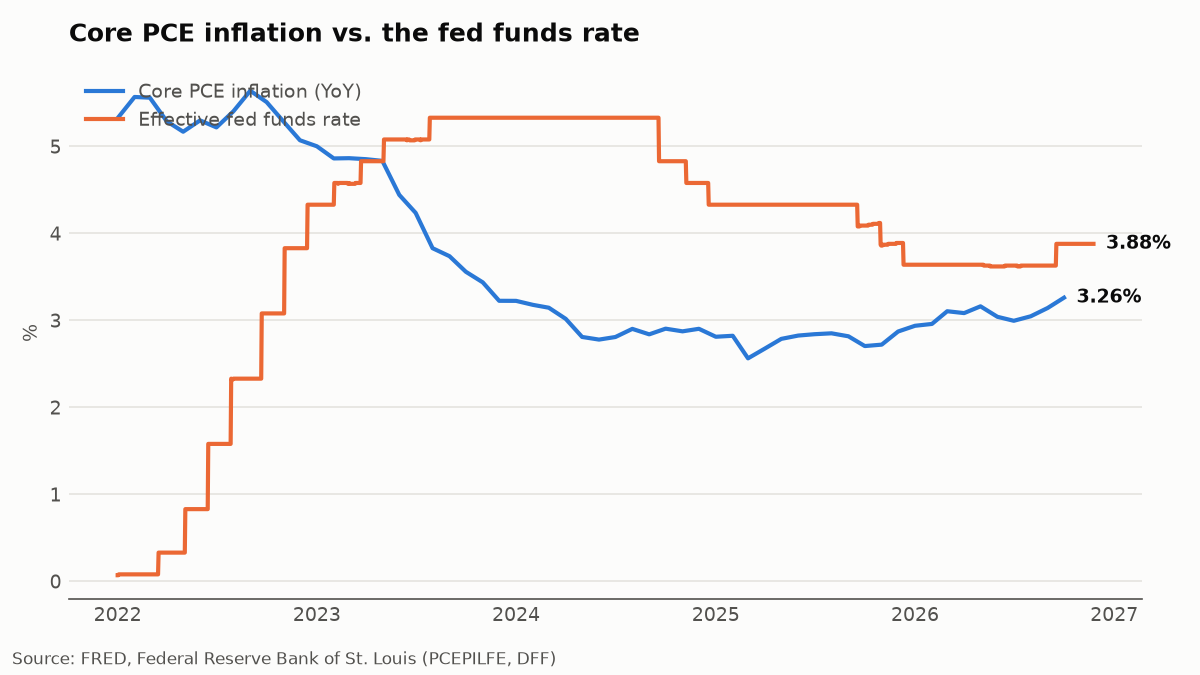
Core PCE rose from 2.72% in November 2025 to 3.26% in October 2026, while the effective fed funds rate held at 3.88% from Nov. 13 through Nov. 17.
That drift is why the hawks want more. Governor Christopher Waller is pushing for a half-point hike (FT). St. Louis Fed President Alberto Musalem has sketched a case for three more increases next year (WSJ). Markets price 71 basis points of hikes by mid-2027, though Jefferies doubts the Fed delivers that much (WSJ).
Can a Jobless Expansion Take the Hit?
How can GDP boom if hiring is barely happening? Real Investment Advice notes the economy grew 2.2% in the year to the second quarter of 2026 while payrolls grew just 0.3%. Hiring averaged about 41,000 jobs a month over the year through September, with four negative months. Unemployment still dipped to 4.2% from 4.4%, because the labor force shrank by roughly 1 million as boomers retire and immigration slows (RIA).
That's stable, but brittle. RIA argues a flat workforce with productivity near 2.2% caps growth around 2%. RIA also cites economist Byron Gangnes, who found AI's biggest boost to growth came through the stock market's wealth effect, not the spending itself (RIA). BlackRock's Rick Rieder says stocks make up over 70% of households' liquid assets (Barron's).
So the stock market is propping up spending, and spending is already cooling. Before the latest rout, Goldman's David Mericle estimated tighter financial conditions would trim 0.5% off growth from late 2025 to late 2026 (Barron's).
Opposing Views
The Bull Case
Deutsche Bank's Henry Allen says every S&P 500 bear market since 1962 came with a recession, worsening data, or a hawkish Fed shift. Allen sees none so far: the November flash composite PMI sits at 54.6, signaling expansion, and rate pricing has turned slightly dovish (CNBC).
Households also have a cushion. Personal income rose 0.7% in October, and the savings rate climbed to 4.1% from 3.6% (Axios). Jefferies expects the December meeting to mark peak Fed hawkishness (WSJ).
The Bear Case
Barron's Randall Forsyth argues falling stocks plus rising rates threaten an economy leaning on wealthy consumers and AI (Barron's). Forsyth also points to a flattening yield curve, which Capital Economics warns is a further red flag for equities (Barron's).
Bill Ackman claims continued hikes would push the US and the world into recession (FT). Apollo's Torsten Sløk says the turmoil argues for caution (FT). RIA concedes a low-hire, low-fire market only holds while firing stays low; once layoffs start, there's little hiring momentum to absorb them (RIA).
Conclusion
The Fed is treating the selloff as part of the cure, not a reason to stop, so investors can't count on a rescue. The real test is whether an expansion built on AI investment and stock-fueled spending survives the Fed deliberately cooling both.
Expect a quarter-point hike on Dec. 9; the bigger question is how many follow.
Watch core services inflation, now 3.6%, more closely than headline numbers.
Weekly jobless claims are the tripwire for the low-fire labor market.
Further yield-curve flattening would signal markets expect the Fed to overtighten.
A deeper stock slide than the current correction is what it would take to shift the Fed.
Sources
Inflation Refuses to Go Back into the Bottle: PCE Price Index Worst YoY since 2023, on Services, Electronics, Energy - Wolf Street (RSS), 2026-11-25
Upgrade to US GDP figures keeps December rate rise in play for Fed - FT, 2026-11-25
Beige Book confirms hot US economy and signs of wage pressure building - FT, 2026-11-25
Hawkish Fed poised to raise rates despite stock market turmoil - FT, 2026-11-26
Wild Market Swings Are Colliding With a Fed Bent on Taming Inflation - WSJ, 2026-11-26
U.S. Treasury Yields Rise in Shortened Post-Thanksgiving Trade - WSJ, 2026-11-27
Warsh’s ‘good family fight’ could turn ugly - FT, 2026-11-27
The U.S. economy is ripping - Axios, 2026-11-25
The S&P 500 is in a correction. Bear markets and recessions don't always follow - CNBC, 2026-11-27
Stocks’ Swoon and Higher Interest Rates Are a Bad Combo for the Economy - Barron's, 2026-11-26
Jobless Growth: What A Shrinking Workforce Means For Investors - Real Investment Advice Ria Bull Bear Report (RSS), 2026-11-27
Core PCE inflation vs. the fed funds rate - Source: FRED, Federal Reserve Bank of St. Louis (PCEPILFE, DFF)
Core PCE inflation vs. the fed funds rate - Source: FRED, Federal Reserve Bank of St. Louis (PCEPILFE, DFF)
Thanks For Reading!
If you have any source you wish to see in our lineup, please reach out and let us know.
It's been a while since our last issue. If these emails aren't for you anymore, you can unsubscribe here, no hard feelings.
December 2018 is the closest precedent: the Fed hiked with the S&P about 14% off its high, then pivoted within six weeks. With core PCE at 3.3% this time, do you see any room for a 2019-style U-turn?