

Friday was the day the AI trade cracked in public. Intel collapsed 29% to $65.76, its steepest one-day fall since 1974, after a weak fourth-quarter forecast tied to slumping PC sales. Amazon slipped 1.4% as its ad growth cooled.
The Nasdaq Composite dropped 2.86% to 25437.00, its worst session since June 5 and its worst month since March 2025 (WSJ). The S&P 500 lost 1.82% to 7580.07 (WSJ). Axios counts $1.2 trillion in Nasdaq value erased in October (Axios).
The earnings misses steal the headlines, but for a regular investor they're a sideshow. Is this a healthy markdown of overpriced AI winners? Or is it the start of an unwind, driven by the borrowed money behind the AI build-out? That answer is in the debt markets.
The Stock Selloff Is Narrow. The Credit Stress Is Not.
How can the market be breaking if most stocks went up last week? Real Investment Advice points out that nine of 11 sectors rose and the equal-weight S&P 500 gained 0.8% (RIA). RIA notes the damage was almost all in tech and communication services (RIA). Judged by stocks alone, that's a rotation, not a rout.
Debt tells a different story. Credit-default swaps are insurance that pays if a company defaults. According to bond data provider Solve, swaps on Amazon, Alphabet, Microsoft, Meta and Oracle climbed over the past month to their highest levels since 2021 (WSJ).
Oracle's protection cost jumped by more than 1 percentage point (WSJ). These are some of the strongest balance sheets on earth.
Further down the ladder it gets uglier. "The weak links are going to suffer first," Pimco CIO Dan Ivascyn told the WSJ.
CoreWeave bonds issued at 9.75% earlier this year now yield above 15% (WSJ).
Neoclouds, the firms that build data centers and rent out AI computing power, such as CoreWeave, Nebius and Nscale, have been all but locked out of new bond deals lately (WSJ).
Financing Costs Matter More Than Any Earnings Miss
The build-out runs on credit. By Bank of America's count, AI-related borrowing across U.S. corporate debt reached $655 billion as of mid-October, versus $394 billion for all of 2025 (WSJ). Analysts look for close to $1 trillion next year (WSJ). When that money gets pricier, every project gets harder to pencil out.
And it is getting pricier. The Fed raised short-term rates in September for the first time in three years (WSJ). The Fed held at 3.75% to 4.00% last week, and futures price roughly an 85% chance of a December hike (RIA). Even Alphabet posted negative free cash flow of $9.1 billion against $51.4 billion of quarterly capital spending (RIA).
The wider junk market is cracking at the bottom. The FT reports yields on CCC-rated debt, the lowest rung of junk, have topped 18 per cent in the U.S., up from about 15 per cent in January (FT). Pimco's Lotfi Karoui argues stronger borrowers can handle higher rates, while CCC companies have little room to maneuver.
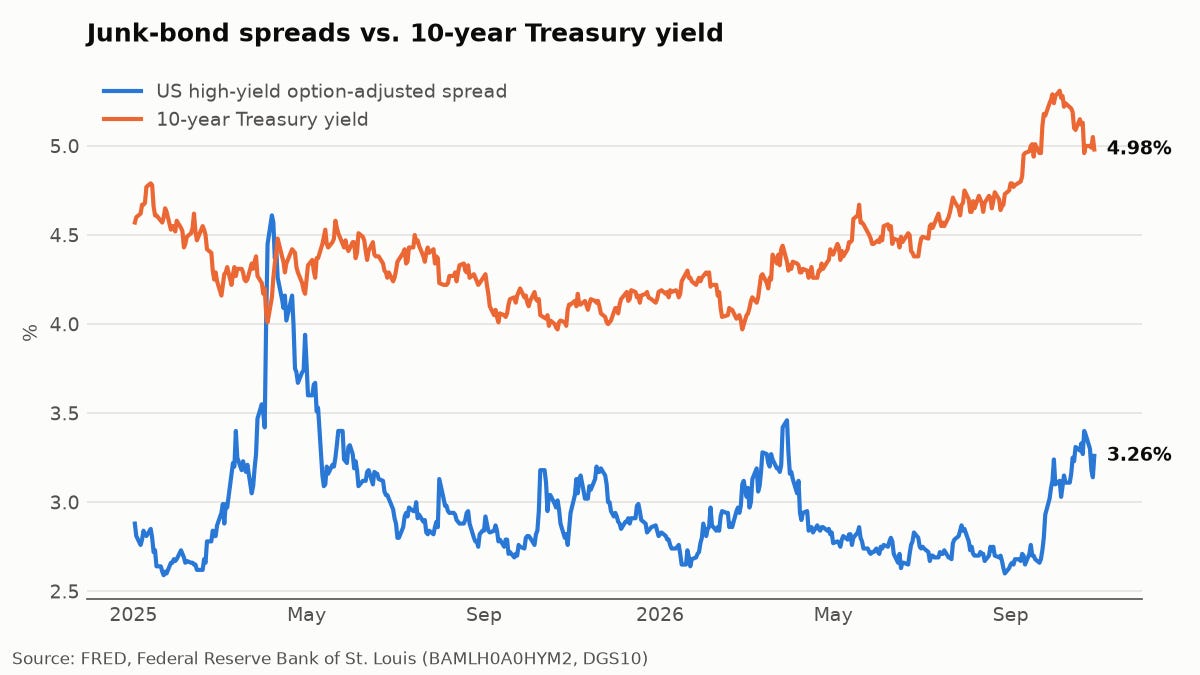
The broad junk spread stood at 3.25 percentage points on Oct. 14 and 3.26 on Oct. 29. Over the same stretch, the 10-year yield eased from 5.19% to 4.98%. So the stress is concentrated in the weakest borrowers rather than across all of high yield.
That is the line to watch. If the broad spread starts climbing too, the unwind is spreading.
Investors Are Already Buying Insurance
Put options on CoreWeave, which pay off if the stock falls, hit record volume this month, according to Cboe data (WSJ). Jump Trading has launched a desk that lets data-center operators hedge against falling compute rental prices. "You don't need to be bearish to want some insurance," said Jump president Dave Olsen (WSJ).
Anyone counting on a bond fund for safety should take note. BCA Research says corporate bonds no longer diversify AI risk well (Barron's). BCA's reasoning is that hyperscalers, neoclouds and chip makers are all heavy borrowers (Barron's).
Opposing Views
The Bull Case
Generali's Thomas Hempell, writing in Barron's, cautions against writing off the build-out. Hempell argues demand for AI tools and computing power should keep growing fast.
Ed Yardeni points to Anthropic's IPO filing: first-half revenue jumped from $1.2 billion to $16.3 billion, and it holds $131.7 billion in cash and short-term investments. Strategist Luke Lango notes chip makers still report exponential growth in AI orders (WSJ). Microsoft's Azure grew 48% (RIA).
The Bear Case
WSJ columnist James Mackintosh warns the money is circular. Mackintosh notes that Nvidia, AMD and Broadcom put $5 billion into Meta's $25 billion stock sale (WSJ). Nvidia has also given a $105 billion backstop for an Ohio data center. Telecom-gear makers wrote off billions in similar customer financing in 2001 (WSJ).
Eurodollar University highlights Amazon's $42.4 billion free cash outflow and a new supplier financing facility of up to $80 billion (YouTube). Eurodollar University also flags banks stuck with a bridge loan of roughly $15 billion for a Texas data center after the state paused new projects (YouTube). PGIM's Robert Sockin now puts recession odds at maybe 25 per cent (FT).
Conclusion
The stock selloff alone looks like a repricing. But the debt behind AI is where an unwind would start, and the weakest borrowers are already shut out.
Watch the broad junk spread; a sustained climb would signal stress spreading beyond neoclouds and CCC credits.
Rising Fed rate expectations hurt heavily indebted AI builders more than any one earnings miss.
Don't assume a corporate bond fund protects you from AI risk.
Check whether a tech company's growth relies on borrowing or circular deals with its own suppliers.
Hedging is a sign of caution, not panic; size positions so you don't need to sell into a credit scare.
Sources
U.S. Stocks Slide as Amazon, Intel Earnings Spark More AI Selling - WSJ, 2026-10-30
The Tangled Web of AI Bets Is Reason to Fear Tech Stocks - WSJ, 2026-11-01
AI Investors Are Racing to Get Insurance on the Biggest Market Bet in History - WSJ, 2026-11-01
The New Bottleneck in America’s AI Build-Out: A Shortage of Cheap Money - WSJ, 2026-10-31
Junk debt rout sparks ‘bloodbath’ for credit investors - FT, 2026-11-01
Investors trim growth bets over fears of US economy’s AI exposure - FT, 2026-10-31
SOX Folded, CoreWeave Unraveled, Investors Fled. But Don’t Write Off the AI Buildout Just Yet. - Barron's, 2026-10-30
The AI trade's trick-or-treat earnings season - Axios, 2026-10-31
Growth vs Value Hit An Extreme As AI Spending Broke Big Tech - Real Investment Advice Ria Bull Bear Report (RSS), 2026-10-31
The AI Bubble Is Now A Debt Disaster - Eurodollar University (YouTube)
Junk-bond spreads vs. 10-year Treasury yield - Source: FRED, Federal Reserve Bank of St. Louis (BAMLH0A0HYM2, DGS10)
Junk-bond spreads vs. 10-year Treasury yield - Source: FRED, Federal Reserve Bank of St. Louis (BAMLH0A0HYM2, DGS10)
Thanks For Reading!
If you have any source you wish to see in our lineup, please reach out and let us know.
It's been a while since our last issue. If these emails aren't for you anymore, you can unsubscribe here, no hard feelings.