

The Fed's favorite inflation gauge moved the wrong way again. The PCE price index rose 3.8% in October from a year earlier, its worst reading since May 2023. Core PCE, which leaves out food and energy, climbed to 3.3%, the highest since November 2023 (Wolf Street). The Fed's target for both is 2%.
On the same day, the government revised third-quarter GDP growth up to a 4.3% annualized pace, from 3.4% first reported (Axios). Add a Beige Book showing wage pressure building, and traders now put the odds of a quarter-point hike in December at 95% (FT). Strong growth usually helps stocks. This time it is the reason the Fed keeps tightening.
The Economy Is Too Strong for Its Own Good
The headline GDP number was not a fluke. The details show demand running hot across the private economy:
Real final sales to private domestic purchasers grew at a 5.8% rate, up from 4.9% in the first estimate. This measure leaves out trade, inventories and government, so it tracks underlying private demand (Axios).
Consumer spending rose 4.2% in Q3. Business investment outside housing jumped 16.1%, driven largely by the AI buildout (Wolf Street).
Only 189,000 people filed new jobless claims last week, tied for the lowest reading of 2026 (Axios).
The Beige Book upgraded wage growth to moderate from modest. Four of 12 districts reported faster wage gains, driven by higher living costs and a shortage of skilled workers (FT).
Barron's calls this a paradox for investors. In Barron's view, growth has propped up earnings and valuations all year, but that strength, paired with rising prices, makes it hard for the Fed to back away from hikes (Barron's). Chris Rupkey, chief economist at Fwdbonds, argues that prices won't cool while demand keeps running this hot (CNBC).
This Is Not Just a Gasoline Problem
The easy story is that the spring energy spike pushed inflation up and it will fade. The chart doesn't buy it.
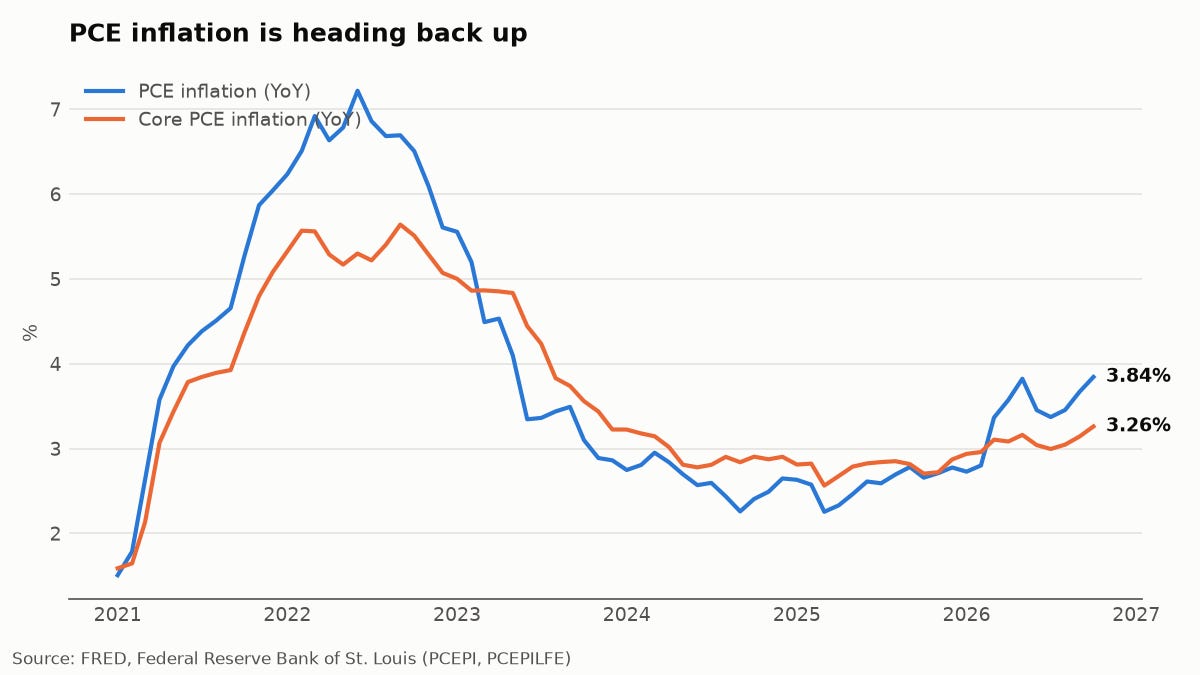
Headline PCE inflation rose from 2.71% in November 2025 to 3.84% in October 2026, while core rose from 2.72% to 3.26% over the same stretch (Source: FRED, Federal Reserve Bank of St. Louis).
Gasoline is up 37.8% from a year ago, but Wolf Richter points to a bigger worry: core services inflation hit 3.6%. Core services make up over 60% of consumer spending, and once prices spread there, they are hard to pull back. Airfares are up 14.4%. Computers, software and related gear are up 14.6%, which Richter ties to the AI buildout (Wolf Street).
Momentum is also building. The three-month annualized rate of core PCE climbed to 3.6% in October from 3% in September (Barron's). The WSJ reports Fed officials now worry that AI-driven demand, unlike an oil shock or tariffs, will not fade on its own (WSJ).
CNBC's Steve Liesman adds context. In 1995, when Alan Greenspan held rates steady through the dot-com boom, the inflation-adjusted fed funds rate was a positive 3.75%. Today it sits at zero, so the Fed could arguably be fueling this boom rather than leaning against it (CNBC).
Don't Count on a Fed Rescue
Investors have long relied on what Wall Street calls the "Fed put": the belief that the central bank will ease off when stocks fall hard (WSJ). That bet looks flimsy now. The S&P 500 was down 2.8% by late morning Wednesday (Axios), and Nasdaq futures fell close to 3% before the open (Barron's).
The WSJ notes that Fed Chair Kevin Warsh urged the Fed to pause tightening in December 2018, when stocks were down about 11%. But back then, inflation had only just reached the Fed's 2% target after running below it for years. Today it has run above target for more than five years, and Warsh has said he won't accept inflation even modestly above it. Former Boston Fed President Eric Rosengren argues a selloff that cools AI investment may be exactly what the Fed wants (WSJ).
Traders now price hikes at both the December and January meetings. Barron's warns that a longer tightening cycle threatens earnings, and that higher bond yields make future profits worth less today (Barron's).
The WSJ also notes the dollar has been strengthening as rates rise (WSJ). One caution: Treasury yields fell sharply right after Wednesday's release (CNBC), so the bond market is not moving in a straight line.
Opposing Views
The Bull Case
The consumer may already be cooling. Inflation-adjusted spending was flat in October, and the saving rate rose to 4.1% from 3.6% (Barron's).
The WSJ reports some officials could stop after one more hike if recent drops in oil and commodity prices hold (WSJ). Traders also cut the odds of a third hike to about 1-in-3 from 50-50 (CNBC). And Liesman allows that AI spending may eventually bring more productivity and lower inflation (CNBC).
The Bear Case
David Rosenberg of Rosenberg Research believes October 6 marked the cycle peak for the S&P 500 and expects unemployment to rise well above 6% (Wealthion). The WSJ notes stocks now make up 35% of household net worth, versus 26% at the dot-com peak, so a slide would hit spending harder. Former Fed governor Jeremy Stein thinks the fallout from an AI bust could exceed the dot-com hit (WSJ).
Conclusion
Good economic news is now bad market news. The hotter growth runs, the more room the Fed has to keep hiking into a shaky AI-led market.
Expect a December hike; watch whether January follows.
Track core services inflation, not gasoline, for the real trend.
Don't assume the Fed will cushion an AI selloff.
Weak consumer spending data would be the first sign of relief.
Higher rates raise the bar for richly valued growth stocks.
Sources
Fed’s preferred inflation gauge accelerated to 3.8% in October, raising the 2027 stakes for the central bank - CNBC, 2026-11-25
Inflation Refuses to Go Back into the Bottle: PCE Price Index Worst YoY since 2023, on Services, Electronics, Energy - Wolf Street (RSS), 2026-11-25
Upgrade to US GDP figures keeps December rate rise in play for Fed - FT, 2026-11-25
U.S. economy grew at rapid 4.3% pace in third quarter - Axios, 2026-11-25
Beige Book confirms hot US economy and signs of wage pressure building - FT, 2026-11-25
The U.S. economy is ripping - Axios, 2026-11-25
Our Rate-Hike Economy: Sizzling Private-Sector Economic Growth, Hot Inflation. - Wolf Street (RSS), 2026-11-25
Liesman: Why Greenspan could bet on productivity — and Warsh needs to hike - CNBC, 2026-11-25
Wild Market Swings Are Colliding With a Fed Bent on Taming Inflation - WSJ, 2026-11-26
Hot Inflation and Strong Growth Raise the Risk of More Fed Rate Hikes - Barron's, 2026-11-24
3 Warning Signs as the AI Selloff Gets Ugly Again - Barron's, 2026-11-25
S&P 500 to 5,500? Why This Rebound Could Be a Trap | David Rosenberg - Wealthion (YouTube), 2026-11-24
Worse Than the Dot-Com Crash: What an AI Bust Could Mean for the Economy - WSJ, 2026-11-25
PCE inflation is heading back up - Source: FRED, Federal Reserve Bank of St. Louis (PCEPI, PCEPILFE)
PCE inflation is heading back up - Source: FRED, Federal Reserve Bank of St. Louis (PCEPI, PCEPILFE)
Thanks For Reading!
If you have any source you wish to see in our lineup, please reach out and let us know.
It's been a while since our last issue. If these emails aren't for you anymore, you can unsubscribe here, no hard feelings.